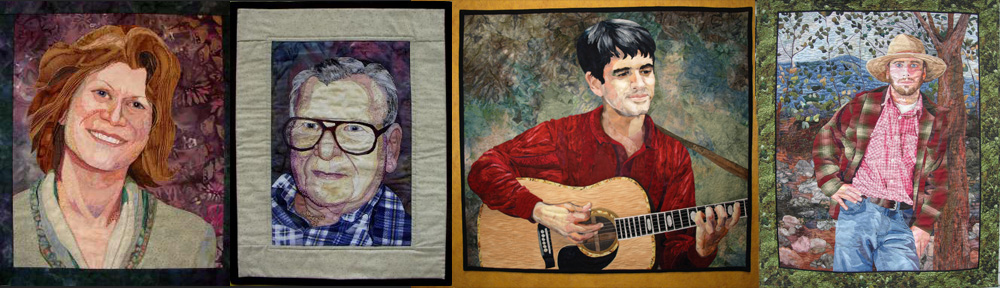
M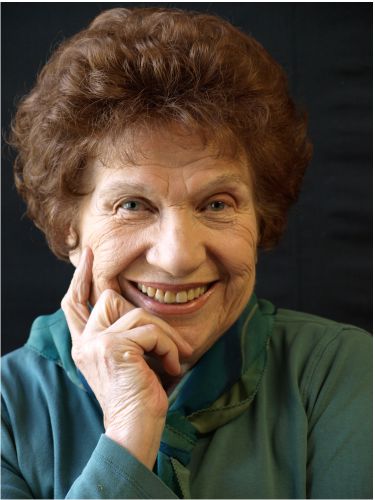 arilyn Belford is an award-winning quilter, well known for her realistic fabric portraits and art quilts. She comes to the quilting community after a long, successful career in the art world. Marilyn finds the congeniality of quilters a delight. Having been brought up in a home where sewing was paramount, it is no surprise that she now combines her love of art and sewing in a new career in quilting. It was after moving up to Chenango Forks, NY, from Brooklyn, NY, that her interest in quilting was sparked. Her first portrait quilt was made in December 1999 and was an immediate success, winning prizes wherever shown.
In talking about her portrait quilts, Marilyn says, “A face expresses much emotion. It can tell a complete story in a single viewing. I try to stitch a personality rather than just a face. It is in the details that the emotions rest. I try to give my students the technical background to enable them to produce a portrait in fabric that makes their loved ones seem to breathe.”
Her works have been shown at the AQS show in Paducah, Quilters’ Heritage Celebration in Lancaster, the IQA International Show in Houston, TX, the Schweinfurth Museum in Auburn, NY and other museums and shows nationally, winning many awards.
Marilyn has been teaching at Quilt University since 2003. She has written an article on her method for Chitra Publication’s magazine Quilting Today, has been featured in ARTSmagazine, and has been favorably reviewed in newspapers in New York.
****
To see Marilyn Belford’s quilts is to be impressed by her deep artistic background. Her use of colors and shapes is amazing in its evocative effect. The finished pieces exude her boldness in design and vision. “I have always had a penchant for the dramatic,” Marilyn admits. “Plays such as Medea, music by Beethoven, and paintings like Guernica by Picasso and German expressionism have always been my preferences. Strong colors like reds and yellows make me tingle.”
In her quilting Marilyn draws on both her artistic training in NYC and her rich Jewish heritage to create her colorful work. “My love of fabric is an extension of my love of color, texture, and shapes,” she says. “Fabric in itself is a tool, just like paint is a tool. I use whatever tool is necessary to reproduce the vision inside of me. I enjoy searching out fabric all over the vicinity that will make the appropriate statement for me. I spend delightful hours looking for “angry” fabrics, or “biblical” colors, or for fabrics that will look like an unshaven face.” This love and care for her work resonates with those who see the quilts, praise and prizes coming wherever the sewing is shown.
Struck By Lightning
It was while browsing through a fabric store that Marilyn stumbled upon art quilting. “It was as if I were struck by lightning,” she explains. “I loved sewing and I loved painting. The art quilt combined the two. That was all I needed. Off I went exploring this new avenue.”
Inspired by Deidre Scherer’s portrait of an elderly couple, she set out to make a quilt of her own deceased parents. “I loved working on that piece,” Marilyn remembers with a smile. “I ‘talked to them’ as I worked on it. It was as if they gave it to me.” “My Parents” was an immediate success, eventually winning prizes on the local, state, and national level.
“I find new challenges inspiring,” she says, and it shows in her work, from portraits to bible stories and quilts of famous paintings. Marilyn not only loves conquering new challenges but helping others succeed as well. At the suggestion of a friend, Marilyn took up teaching the joy of art quilting. “There is great pleasure in seeing a skeptical student produce a beautiful art quilt and listen to their comments on how they never believed they could ever have done what they did,” she says happily.
For her teaching Marilyn draws on her own experience with her first art quilt. “While playing around on the computer it dawned on me that technology can be great for art and can make the life of the artist so much easier,” she says with a grin. “I printed the photo onto a transparency film and projected it onto muslin and traced it. ‘How nice’ I said to myself, ‘I don’t even have to know how to draw!'” From this idea Marilyn has developed a curriculum that can teach those who can’t draw how to create art quilts, or even a quilt portrait. “I am happy when I hear of a student continuing to make more art quilts, and I get very excited when they bring me their recent work and I see the blossoming of their skills.” Always ready with a smile and words of encouragement, Marilyn helps others and continues to find new excitement in her own quilting adventures.
 Marilyn Belford
Dear Mrs. Belford. I love your art. I have signed up for your emails. I am a friend of Francis. Everyone loves her. Maybe I could get your book at the Caldwell Library. Happy New Year. Maureen Mingle, Essex Fells, New Jersey.
Mrs. Belford. I’ve purchased your book and have had a senior moment and now can not find it. What computer program did you say you used to create your posterizing. I remember it started with a J _ _ _. I did go out and buy a program and am not happy with it at all. Your book is truely easy to follow. Now if I could just find my copy. I plan on going on the internet and finding the software that you use. Thank you, Lois H. of Lawrence, KS.
Dear Marilyn, Where can I order your book “Portaits in Fabric”?
I believe Amazon has it. Give that a try. If you have any problems, let me know.
Marilyn
You are thinking about ‘Jasc’. They were taken over by CorelDraw. I use CorelDraw Graphic Suite. Good luck with your portrait.
Marilyn
Some years ago, I saw your quilt “Rundy” at a quilt show. I was mesmerized by this quilt! Your use of fabrics was amazing! It was hard to stop looking at Rundy’s face. I am a fan of all of your quilts, but wanted to tell you how much I love this particular one. Thanks for an inspirational work of art!
Hi marilyn! It’s me, Sarah Lynn from Binghamton. We moved to Jerusalem but we are coming to NY because our youngest son, ayal, is getting married in august. I’ll be in teaneck most of august. Is there a chance to get together?
Hi marylin, I need your phone number! I left it on my fridge! Please call me. I’m in Teaneck. 201-693-6315